
Related products


Grade 2 Extra Help: Maths
$8
Notice: All resources are only available in digital format and downloadable after purchase.
What Our Customers Say
Sometimes the difference between “I can’t do maths” and “I know how to do this!” is simply having enough opportunities to practice.
As children move through Grade 2, maths starts asking more of them. They are no longer only learning to count and recognize numbers. They begin working with larger numbers, skip counting, place value, addition, subtraction, multiplication, division, fractions, time, shapes and other concepts that build on one another.
When one of those foundations isn’t secure, the next concept can suddenly feel much harder than it needs to.
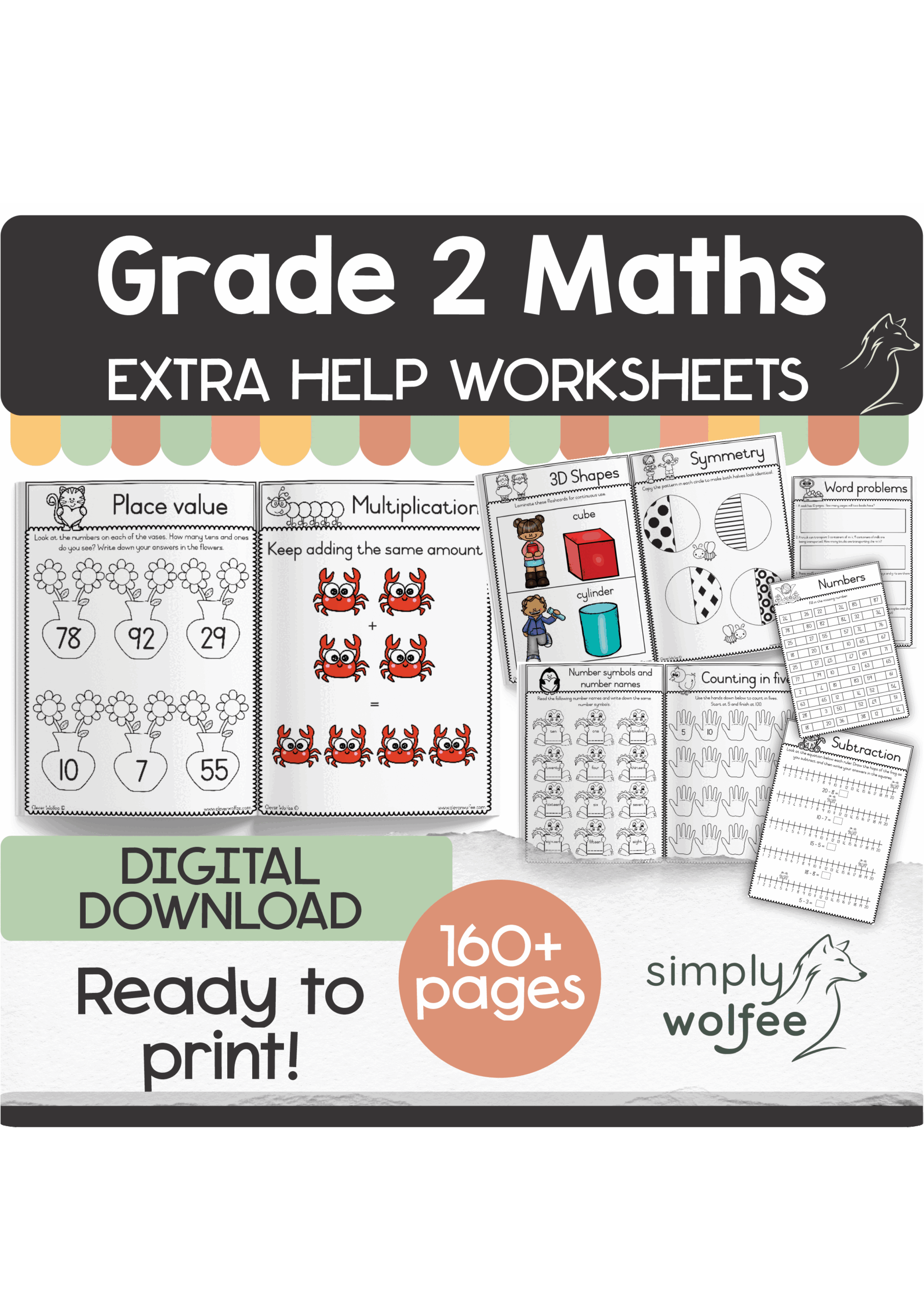
Grade 2 Extra Help: Maths is a comprehensive 153-page printable PDF workbook for children aged 7 years and older, providing a substantial collection of activities for reinforcing and practicing important early maths skills.
Rather than being limited to one maths topic, this resource brings together a wide range of activities that teachers and parents can select according to what a learner needs to practice.
What’s Inside?
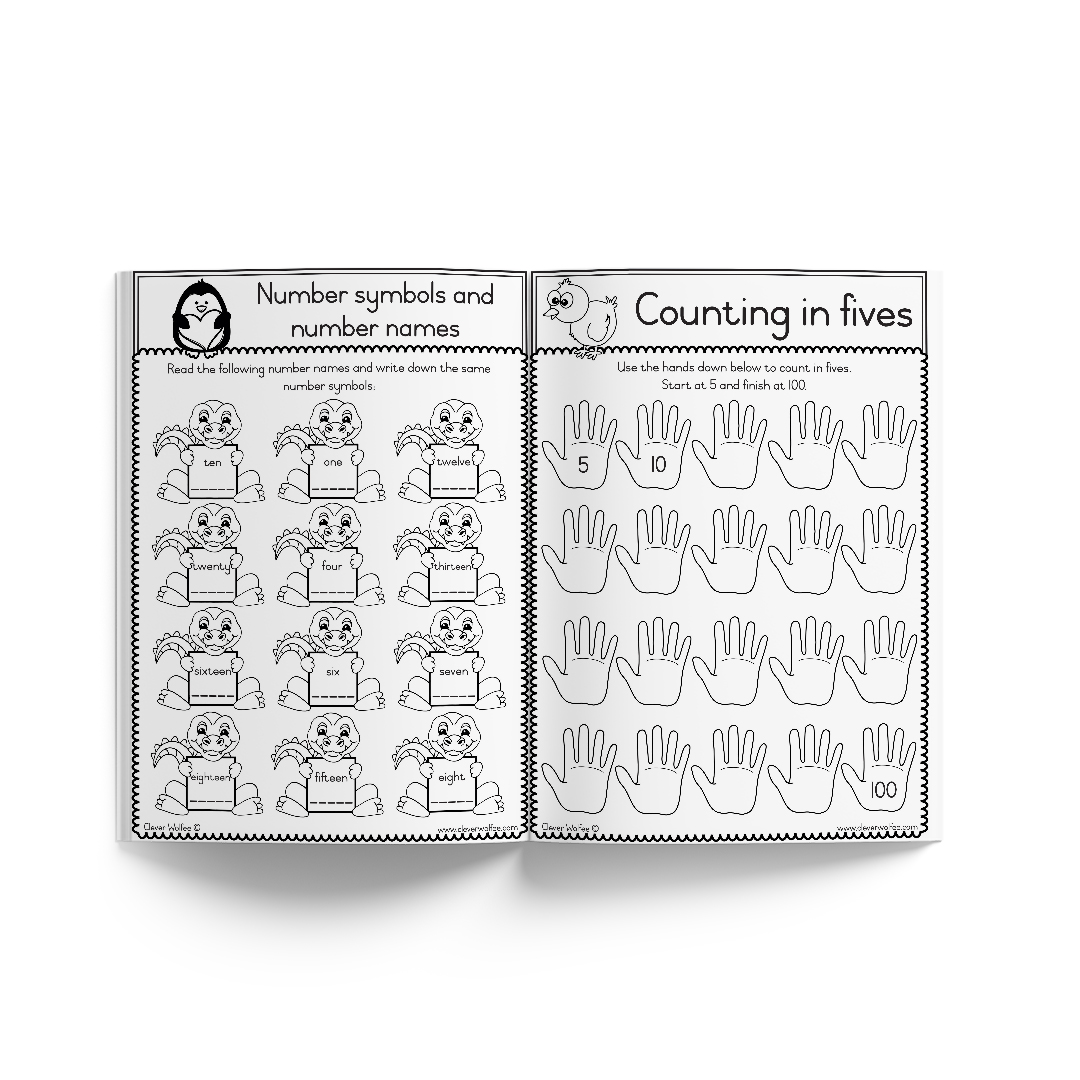
The workbook begins with number symbols and number names, helping children strengthen the connection between a quantity, its numeral and its written name.
Children count objects and write their answers as both a number symbol and number name. They also read number names such as ten, twelve, twenty, thirteen, sixteen and eighteen and convert them into the corresponding numerals. Other activities reverse the process, requiring children to look at a numeral and find or write its number name.
This gives learners repeated practice moving between written number words and mathematical symbols.
Comparing and Ordering Numbers
Knowing a number is one skill. Understanding how it relates to other numbers is another.
The workbook includes least-to-greatest and greatest-to-least activities where children first count groups of objects and then arrange their answers in the correct numerical order.
For example, learners count bunnies, bees, butterfly spots, star teeth and watermelon pips before comparing and ordering the quantities. Some activities extend the task further by asking questions about which group has the most or least and by combining or comparing quantities.
These visual activities encourage children to think about what numbers actually represent rather than simply looking at numerals in isolation.
Skip Counting and Times-Table Foundations
A substantial section of the workbook develops skip-counting skills.
Children practice counting in:
- 2s
- 3s
- 4s
- 5s
- 10s
The activities use child-friendly pictures such as shoes, balloons, acorns, hands and flowers to create number sequences that children complete.
Skip counting is also turned into connect-the-dots activities. Children follow the correct counting sequence to complete a picture and can colour the finished illustration afterwards.
For example, learners connect dots by counting in twos, threes, fours, fives and tens.
The workbook then brings these sequences together in times-table activities, where children complete number patterns for 2s, 3s, 4s, 5s and 10s.
This provides useful groundwork for multiplication because children become increasingly familiar with repeated numerical patterns.
Place Value
Understanding tens and ones is an important part of working confidently with larger numbers.
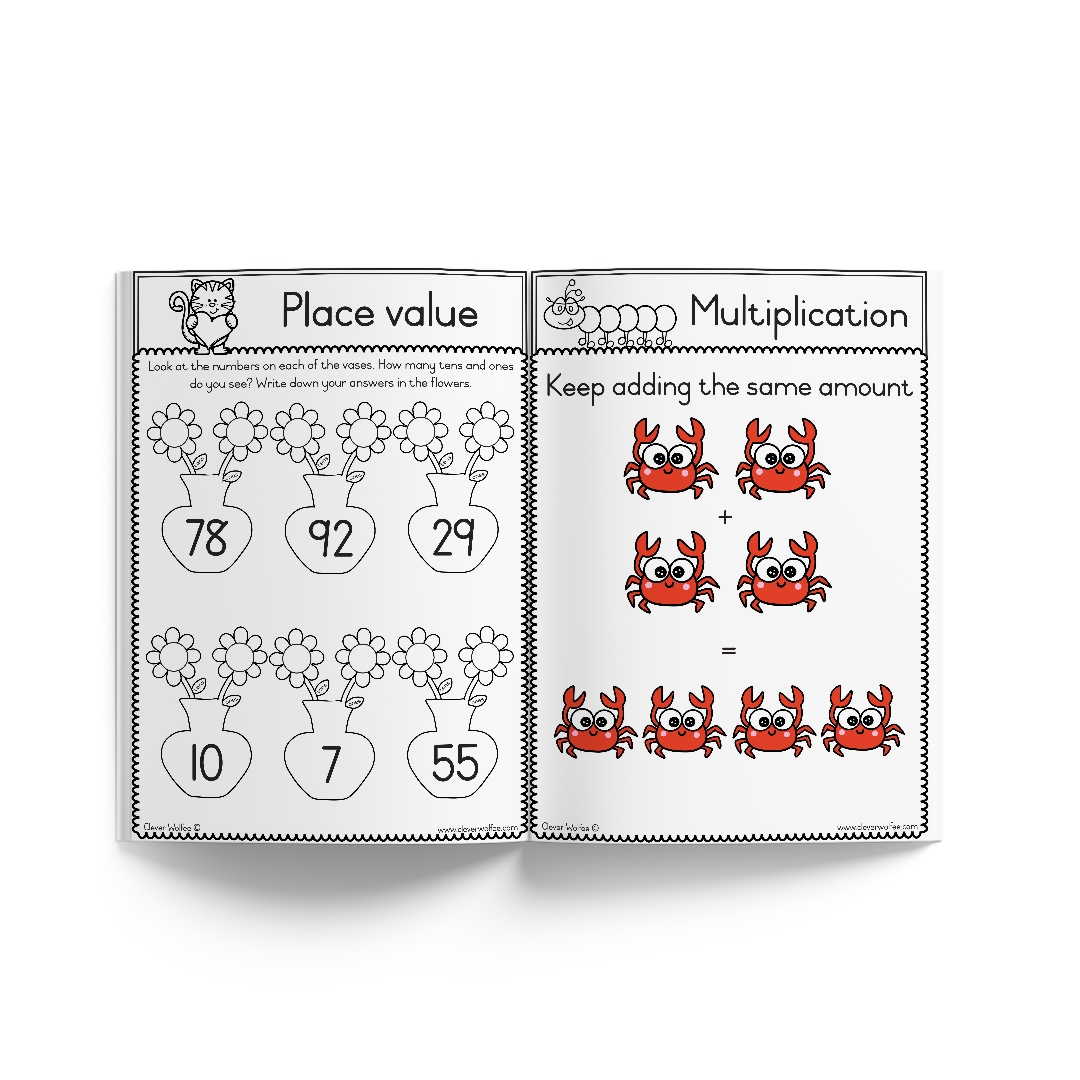
The workbook includes place-value activities where children break numbers into tens and ones and then put those values back together to create a whole number.
For example, children look at numbers such as 14, 23, 47, 36, 88, 75, 52 and 61 and identify how many tens and ones each contains. Other activities give children separate tens and ones and ask them to combine them to find the complete number.
These activities help learners see that a two-digit number isn't simply two numbers sitting next to each other. Each digit has a value depending on its position.
Addition and Subtraction
The workbook provides plenty of practice with addition and subtraction, including calculations involving two-digit numbers.
Children complete addition equations such as 63 + 17, 44 + 22, 25 + 22 and 10 + 80, while other worksheets provide repeated subtraction practice with equations such as 42 − 24, 55 − 25, 45 − 22 and 93 − 72.
There are also worksheets that combine addition and subtraction on the same page, requiring children to pay attention to the mathematical operation rather than automatically applying the same process to every question.
Some activities use pictures such as dice to make calculations more visual, giving children another way to interpret and solve equations.
Introduction to Multiplication
As children become more confident with repeated counting and addition, the workbook moves into multiplication.
Some worksheets introduce multiplication through repeated addition, helping learners understand what a multiplication equation represents rather than treating the multiplication sign as something to memorize.
For example, children complete equations involving multiplication by 2, including 1 × 2, 2 × 2, 3 × 2, 6 × 2, 8 × 2, 9 × 2, 12 × 2 and 20 × 2.
Other activities ask learners to fill in missing values in multiplication equations before calculating the answer.
This creates a useful progression from skip counting to repeated addition and then to multiplication notation.
Introduction to Division
The workbook also provides division practice, allowing children to begin working with the relationship between multiplication and division.
Learners complete division equations and fill in missing amounts before calculating their answers.
Having multiplication and division practice within the same large workbook makes it easier for parents and teachers to revisit earlier skills when a learner needs additional reinforcement.
Fractions
Fractions can feel quite abstract when children first encounter them, so visual examples can make a big difference.
The workbook uses pictures to help children work with parts of a whole.
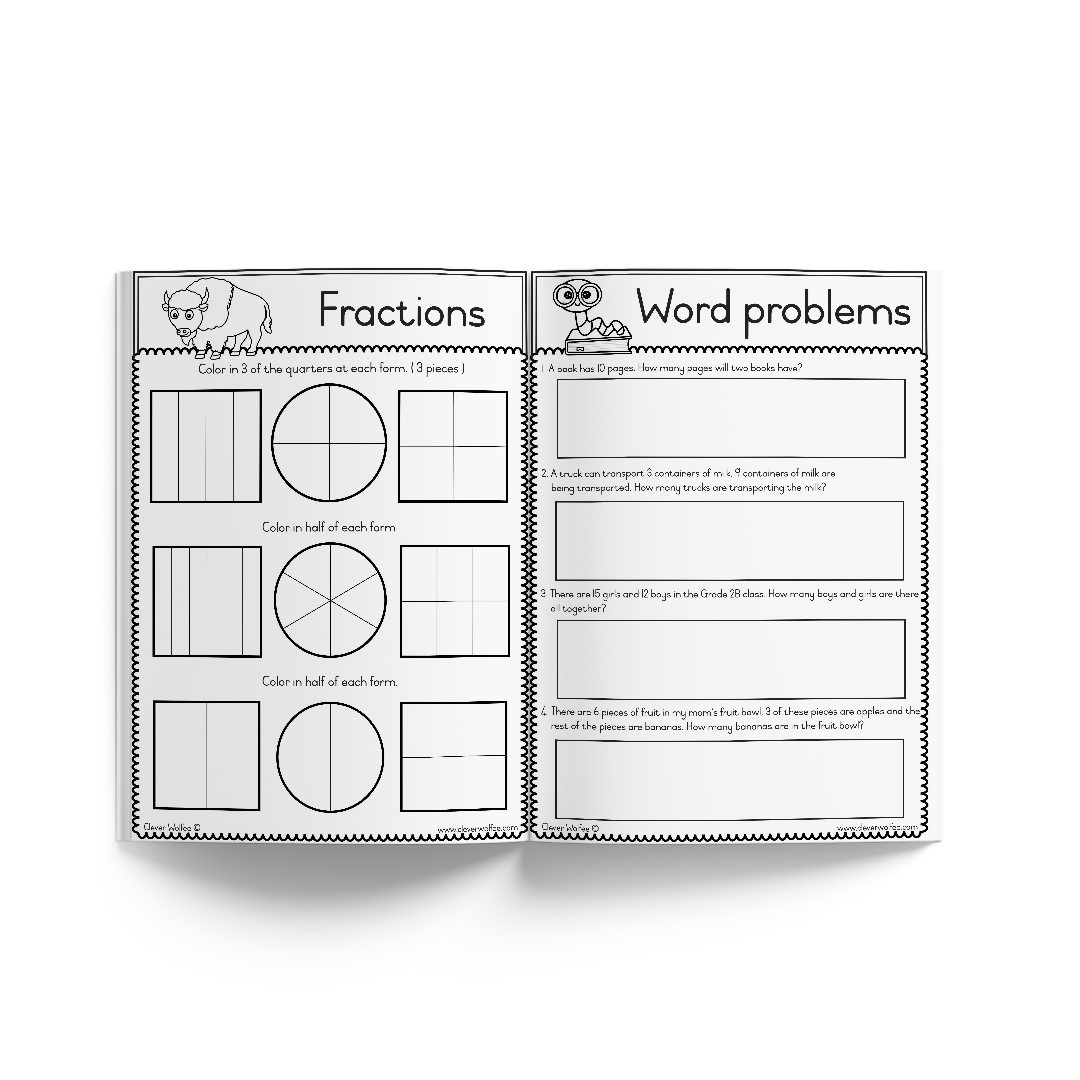
For example, one activity asks learners to look at divided pies and determine how many pieces of each pie have been eaten.
Other activities ask children to recognize and compare written fractions, including fractions such as 1/4, 2/4, 2/8, 4/8, 5/10, 6/8 and 7/10.
This gives children practice working with both visual representations and fraction notation.
Learning About Time
Time is another important practical maths skill included in the resource.
Children work with clocks and time-related language, including quarter past and quarter to.
One activity, for example, explains that all the clocks shown are one hour too early and asks children to calculate and write the time that would be one hour later.
Activities like these encourage children not only to read a clock but also to think mathematically about the passing of time.
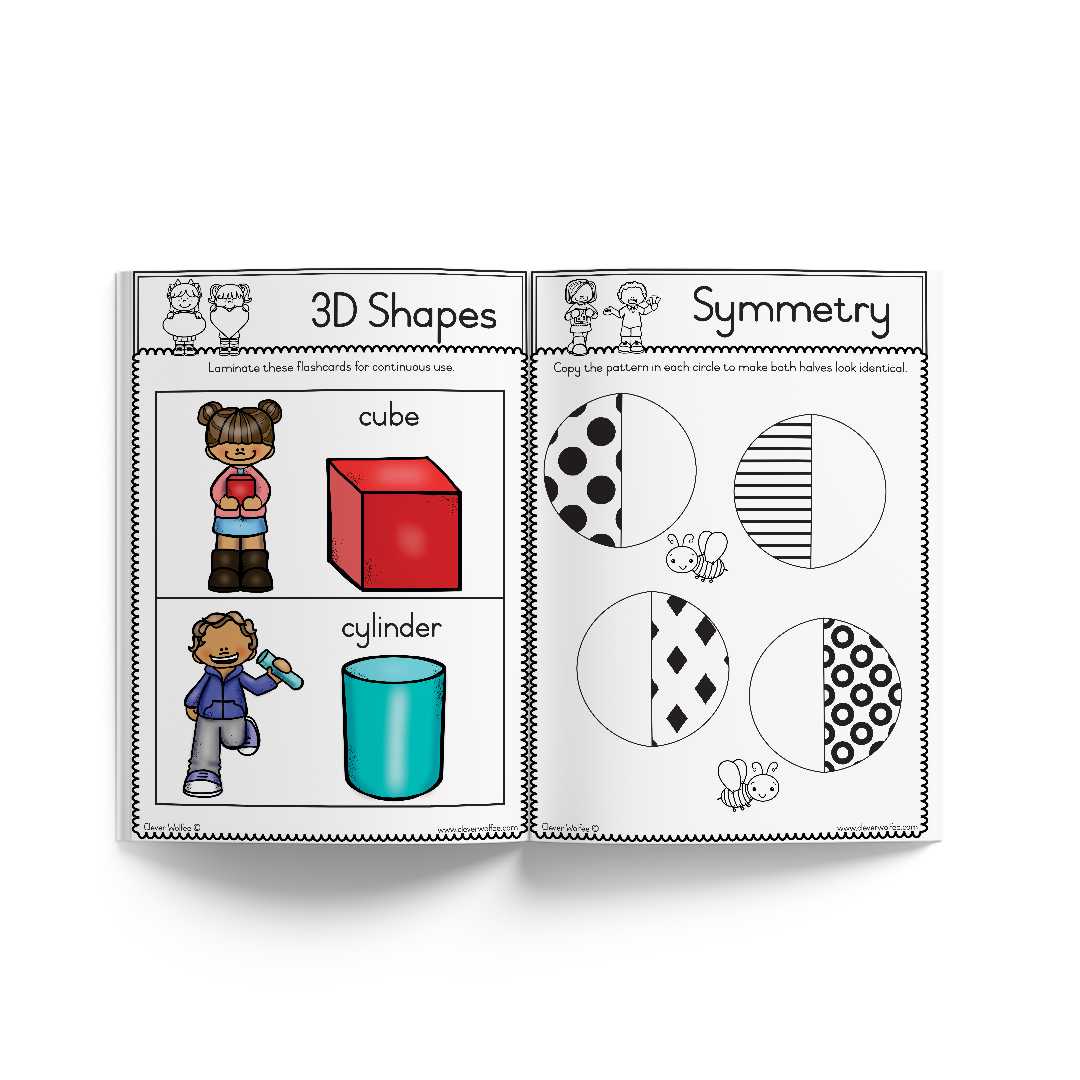
2D and 3D Shapes
Geometry is included through both 2D and 3D shape activities.
Children work creatively with 2D shapes by copying shapes, using different colours and filling them with different patterns.
The workbook also introduces 3D shapes and includes printable resources. The 3D-shape section features shapes such as the cuboid and sphere, with flashcards that can be laminated for repeated use. Other worksheets ask children to recognize specific shapes, such as identifying and coloring cylinders.
This combines shape vocabulary with visual recognition.
Symmetry
Children also explore the concept of symmetry.
The workbook explains symmetry as two sides of a form or picture that look identical to each other.
Learners then apply the concept by drawing lines through pictures so that the two halves would fit perfectly together.
This encourages careful observation and helps children recognize balance and visual relationships within shapes and pictures.
Why Teachers and Parents Will Love It
One of the hardest parts of helping a child with maths is that a learner rarely struggles with “all maths”.
They may understand addition but become confused by subtraction.
They might count confidently in ones but struggle to recognize the pattern when counting in threes or fours.
They may know that 47 is “forty-seven” but not yet understand that it consists of 4 tens and 7 ones.
Or perhaps multiplication, fractions or telling the time simply needs to be explained and practiced a few more times.
That is where Grade 2 Extra Help: Maths becomes particularly useful.
With 153 pages, you have a large bank of printable activities rather than a small booklet that focuses on only one concept.
Teachers can choose worksheets to reinforce what is being taught in class. Parents can print activities targeting an area their child needs to practice. Homeschooling families can incorporate selected pages into their existing maths programme.
There is no need to work through all 153 pages at once.
Print the pages you need. Revisit a concept when necessary. Repeat an activity if the child needs more practice. Move on when the skill becomes secure.
That flexibility makes the workbook useful for both targeted support and general Grade 2 maths revision.
Advantages of This Resource
- A substantial 153-page printable maths workbook
- Designed for children aged 7+ years
- Provides additional Grade 2 maths practice
- Covers number symbols and number names
- Encourages children to connect quantities, numerals and written number words
- Includes least-to-greatest and greatest-to-least activities
- Develops number comparison and ordering skills
- Includes counting and quantity-based activities
- Provides skip-counting practice in 2s, 3s, 4s, 5s and 10s
- Includes fun skip-counting connect-the-dot activities
- Reinforces foundations for times tables
- Develops understanding of tens and ones
- Includes place-value activities
- Provides extensive addition practice
- Provides extensive subtraction practice
- Includes mixed addition and subtraction activities
- Introduces multiplication through repeated-number work and equations
- Includes division activities
- Provides visual and written fraction practice
- Includes practical time activities
- Introduces and reinforces 2D and 3D shapes
- Includes printable 3D-shape learning resources
- Develops understanding of symmetry
- Combines calculation with visual and hands-on activities
- Encourages counting, comparing, ordering and mathematical reasoning
- Allows teachers and parents to target individual areas that need reinforcement
- Individual worksheets can be printed again when additional practice is required
- Suitable for classroom support, homeschooling, revision and additional maths practice at home
Age: 7+ years
Pages: 153
Level: Grade 2 / Extra Maths Practice
Topics: Number symbols and number names, number ordering, skip counting, times tables, place value, addition, subtraction, multiplication, division, fractions, time, 2D shapes, 3D shapes and symmetry
Skills: Counting, number recognition, number words, sequencing, comparing quantities, skip counting, place value, calculation, multiplication, division, fraction recognition, telling time, shape recognition and mathematical reasoning
Format: Digital PDF
This is a digital, printable product. No physical workbook will be shipped. After purchase, simply download the PDF and print the worksheets you would like to use. Pencils, crayons, scissors, laminating materials and other physical supplies are not included.
Maths confidence isn’t created by rushing children to the next concept. It grows when they have enough time and practice to understand the one in front of them.
With Grade 2 Extra Help: Maths, parents and teachers have 153 pages of ready-to-print activities to reinforce important Grade 2 concepts, revisit areas that need more attention and give learners the repeated practice they need to approach maths with greater confidence.